#27 Moonglow by Michael Chabon

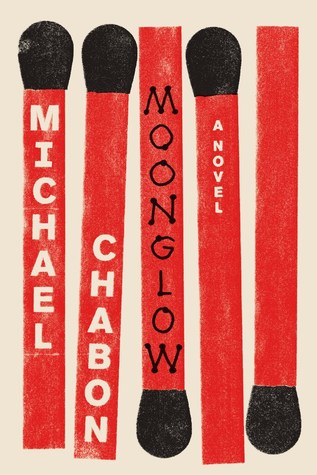
26795307Michael Chabon was the first contemporary fiction author I read as a teenager. At 15 or 16, after reading mostly classics up until that point, I grabbed The Mysteries of Pittsburgh off my mom’s bookcase. I loved it. I was hooked. I went on, through the years, to read Wonderboys: Again, loved it. Werewolves in their Youth: Great. The Amazing Adventures of Cavalier and Clay: Epic, again, loved it. I skipped The Yiddish Policemen’s Union, though I’m not sure why. And then Telegraph Avenue… Couldn’t finish it. I found the writing too forcefully “writerly.” I stumbled on overly wordy sentences and visuals that jarred me out of the book. I experienced some of this jarring, this lack of flow, with Moonglow. It took me four long days to get through, and I never fully lost myself in the story.

The story itself is a patchwork, with Chabon using his grandfather’s own history (growing up Jewish in Philadelphia, his experiences during WWII, meeting and marrying Chabon’s grandmother, his time in prison, his last years) as the foundation of the plot. As with any narrative of this kind, to tell it requires embellishment and the personal story is woven with fictions.

Moonglow is a dense, multi-layered book, and there’s so much I could write about it here: the wealth of moon/space references and allusions, the fascinating/frightening WWII passages, the function of memory in familial narrative and the stories we tell to survive, the effect of war and violence on the psyche… So while I didn’t lose myself in the story, while I struggled at times with the punchy oddness of word choice and felt like I had to work to reach the end, I give Moonglow high marks for evocative scenes, narrative structure, and historical scope.
Save

#26 Station Eleven by Emily St. John Mandel

20170404I don’t usually go for dystopian fiction. Oryx and Crake? Couldn’t get past page 30… In general, I just don’t love end-of-the-world hopelessness, desolate landscapes, and the constant fear that accompanies being one of the few survivors of an apocalyptic change, be it viral or chemical or other.
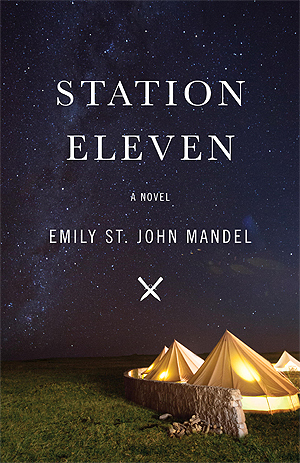
After so many recommendations and great reviews, however, I decided to pick up Station Eleven. Set in the lead-up and 20-year aftermath of a cataclysmic flu that wipes out much of Earth’s population, it follows various characters as they scatter and attempt to survive in the hours, days, and years after a performance of Shakespeare’s King Lear in Toronto.

In the years after the flu pandemic, we get visions of what the world is like from the perspective of Kirsten, one of the children in that production of King Lear in Toronto, who is now an adult player in a traveling symphony/theater that treks from one small enclave of survivors to another bringing music and Shakespearean theater. Post-pandemic, what used to be the U.S. is a place without electricity, planes, phones, the internet, without laws; cities are creepy monuments to a past civilization, full of skeletons, acres of abandoned cars on highways, looted stores and houses, and the echoes of half-realized lives. The visuals that Emily St. John Mandel creates of this world are memorable and terrifying, and it’s a fascinating, compulsive read.

The middle flagged a bit and I kept thinking move it along, move it along. I figured out the reveal pretty early on, and the ending was a bit too tidy and unrealistic for my taste, but overall I give it high marks for story, and character development… and for making me stay up, wide-eyed, two nights in a row imagining what it would be like to live in a Station Eleven world.

Save

#25 Lincoln in the Bardo by George Saunders

29906980

Holy shit. This book. THIS BOOK! Lincoln in the Bardo just might be my favorite book of 2017 thus far.

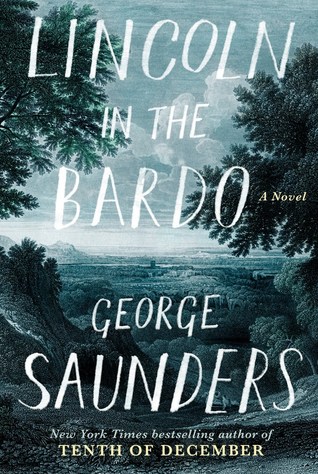
The story takes place in the space of one night in 1862, a year after the start of the Civil War. President Lincoln’s son Willie, dead from typhoid fever, has just been buried in a cemetery in Georgetown. Lincoln, heartbroken over the death of his son, visits Willie’s tomb throughout the night and takes his son’s body out of the coffin so he that might see and hold him once more. He mourns his son, all the while carrying the knowledge and weight of all the deaths accumulating on the battlefields of the war.

Told by a chorus of graveyard inhabitants, and other voices of the period, Lincoln in the Bardo is unlike any other book I’ve read. The graveyard ensemble inhabits this Bardo (a Tibetan concept/word for a “transitional state”), where they welcome new arrivals like Willie, long for the lives they’ve left behind, mourn those they loved and lost, make friends, squabble, and linger with the souls interned around them. At the beginning I thought, is he really going to pull narrative structure off? And yes, he does. George Saunders has managed, brilliantly, to write a book about history, death, and letting go, that is hilarious, strange, and poignant, and that celebrates the smells, tastes, desires, and emotions of life. Bravo.

Save

Save

#24 Ongoingness by Sarah Manguso

22244927Like my copy of Manguso’s 300 Arguments, nearly every page in this slim book is dog-eared; Ongoingness is full of passages I want to return to and sentences that bring on all the feels. In it, Manguso, an avid diarist, writes about the act of keeping a diary. For her, the diary is not only a record of life, but the proof of every day. In an attempt to live with complete awareness, to ward off death, she actively archives experience, builds a document that leaves a trace and pins down memory. This is not the diary itself, but a series of meditations on the act of writing daily, on the formation of identity and how it changes, on parenthood and aging, love and loss, and ultimately the ongoingness of time.

Manguso’s passages about being a new mother, nursing, and the body as vessel struck me at the core:

“In my experience nursing is waiting. The mother becomes the background against which the baby lives, becomes time.

I used to exist against the continuity of time. Then I became the baby’s continuity, a background of ongoing time for him to live against. I was the warmth and milk that was always there for him, the agent of comfort that was always there for him.

My body, my life, became the landscape of my son’s life. I am no longer merely a thing living in the world; I am a world.”

It’s so good.

Save

Save

#23 Neverwhere by Neil Gaiman

23462649

When Richard Mayhew’s boring life in London gets turned inside out for helping a young girl named Door escape the two frightful men pursuing her, he is forced to go underground, literally, to survive. Following Door and her entourage through the tunnels and stations of the London underground, through secret doors and across haunted bridges, as she runs from those who hunt her and searches for the reason her family was murdered, Richard meets Rat-Speakers, murderers, fancy soul-sucking women, Black Friars, fallen angels, sewer-dwellers, and an assortment of other folks who live outside, underneath, beyond the realm of normal.

As the Neverwhere narrative twists and turns, and inverts on itself, I was continually charmed by the quirkiness of the characters, the path of the plot, and the layers of text and subtext that Gaiman weaves throughout. A thoroughly fun and entertaining book…

#22 Was She Pretty? by Leanne Shapton

25664515This quick read by author/illustrator Leanne Shapton, one of the women behind Women in Clothes, is comprised of short, precise descriptions of exes and exes of exes, all accompanied by lovely black and white drawings. What struck me is that the things we remember about exes, and the things our partners remember about their exes, are sometimes quirky, irreverent, and odd, but deeply defining.

Save

Save

#21 Slow Horses by Mick Herron

7929891 Slow Horses is the first book in a series by Mick Herron about MI5 agents who have been relegated, by bad choices they’ve made, the enemies they keep, or circumstances beyond their control, to the backwater of Slough House, an office for fallen/disgraced agents.

The characters are a motley crew, the plot a bit far-fetched, and the pace a little slow at the beginning, for my taste, for a mystery.

I didn’t love this book, but am intrigued enough by the characters and the snappy writing that I might read book two. I discovered this series via librarian Nancy Pearl over on NPR, who notes that the books get better as the series progresses.

#20 300 Arguments by Sarah Manguso

29875902

So many dog-eared pages in this little book, so many bite-sized gems.

“The first beautiful songs you hear tend to stay beautiful because better than beauty, which is everywhere, is the memory of first discovering beauty.”

And.

“I don’t love writing; I love having a problem I believe I might someday write my way out of.”

And.

“I used to avoid people when I was afraid I loved them too much. Ten years, in one case. Then, after I had been married long enough that I was married even in my dreams, I became able to go to those people, to feel that desire, and to know that it would stay a feeling.”

And.

“Like a vase, a heart breaks once. After that, it just yields to its flaws.”

I loved this book so much I went out and bought Manguso’s Ongoingness: The End of A Diary.

Save

Save

Save

#19 This is How You Lose Her by Junot Diaz

13503109

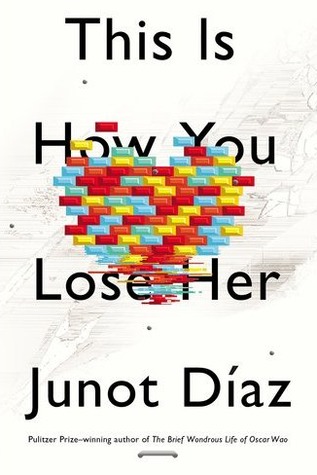
This is How You Lose Her is a vivid, visceral collection of stories by the author of The Brief and Wonderful Life of Oscar Wao.  Many of the stories in this collection feature Yunior, a character Diaz introduced in Drown and, I’ve read, closely resembles the author himself. With Yunior, Diaz treats the reader like a confidant, divulging secrets and indiscretions, making inside jokes, taking us on a ride through lust and betrayal, a journey of the heart. We experience Yunior’s experiences first-hand, his sexual awakening and misconduct, his attempts to know women and his struggles to let them go, we are the voyeurs as the desires of his heart battle with the desires of his body.

Here’s what Leah Hager Cohen over at the New York Times writes: “In the new book, as previously, Díaz is almost too good for his own good. His prose style is so irresistible, so sheerly entertaining, it risks blinding readers to its larger offerings. Yet he weds form so ideally to content that instead of blinding us, it becomes the very lens through which we can see the joy and suffering of the signature Díaz subject: what it means to belong to a diaspora, to live out the possibilities and ambiguities of perpetual ­insider/outsider status.”

Save